The Wellness Triangle
An integrated framework for lasting transformation
Most approaches to self-improvement focus on one dimension at a time — fitness, diet, or mindset.
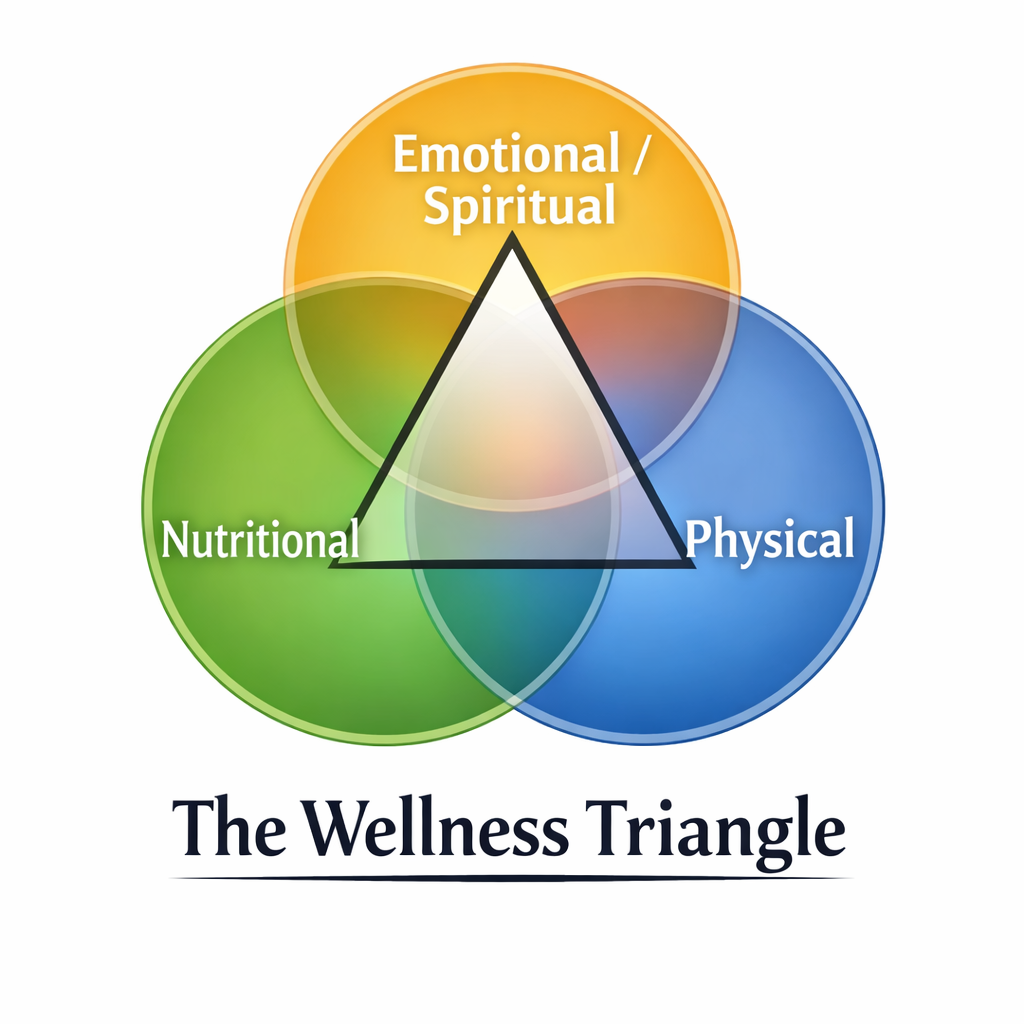
The Wellness Triangle is built on a simple truth: sustainable transformation requires alignment across three interconnected domains.
When the physical, nutritional, and emotional/spiritual dimensions work together, growth becomes stable, measurable, and lasting.
Nutritional Wellness
Foundation
Nutrition is more than calories, macros, or restriction. It is the daily decision to fuel your body in a way that supports clarity, energy, and long-term resilience.
What you consume directly influences how you think, how you move, and how you respond to stress. Misalignment in nutrition often manifests as fatigue, inconsistency, and emotional volatility.
Intentional fueling restores stability to the system.
Alignment
Within The Wellness Triangle, nutrition is not about perfection. It is about alignment.
Alignment means eating in a way that supports your goals, reducing dependence on emotional or stress-driven consumption, understanding how food affects energy and focus, and creating sustainable patterns rather than short-term extremes.
Application
When the nutritional pillar weakens, energy declines, physical performance suffers, emotional regulation becomes harder, and long-term health erodes.
When it strengthens, mental clarity improves, recovery accelerates, discipline builds confidence, and stability increases across the system.
Integration
Nutritional wellness is built by fueling your body in alignment with the life you are building.
Physical Wellness
Foundation
Physical wellness is the structural base of the body. It is the disciplined cultivation of strength, mobility, endurance, and recovery.
The body is not separate from the mind. It influences cognitive clarity, emotional regulation, resilience under stress, and long-term vitality. When physical capacity declines, confidence often declines with it.
Consistent movement restores capability to the system.
Application
When the physical pillar weakens, energy decreases, resilience under stress diminishes, injury risk increases, and confidence erodes.
When it strengthens, posture improves, endurance expands, mental toughness deepens, and the body becomes an asset rather than a limitation.
Alignment
Within The Wellness Triangle, physical wellness is not about aesthetics. It is about capacity.
Alignment means training in a way that supports longevity, building strength that translates into daily life, honoring recovery as much as exertion, and maintaining consistency over intensity.
Physical discipline becomes a practice of integrity — keeping commitments to yourself through action.
Integration
Physical wellness is built by developing a body that supports the life you are called to live.
Emotional/Spiritual Wellness
Foundation
Emotional/spiritual wellness forms the internal architecture of a person’s life. They shape perception, meaning, resilience, and the capacity to navigate uncertainty.
Without internal stability, external success becomes fragile. Emotional reactivity, unresolved conflict, and lack of purpose destabilize the entire system.
Inner clarity strengthens the foundation upon which every other pillar rests.
Application
When the emotional/spiritual pillar weakens, reactivity increases, relationships strain, purpose becomes unclear, and stress compounds.
When it strengthens, stability deepens, decision-making sharpens, relationships improve, and external pressure loses its power to destabilize you.
Alignment
Within The Wellness Triangle, emotional/spiritual wellness is not about constant positivity. It is about awareness and integration.
Alignment means developing emotional regulation, taking responsibility for internal responses, cultivating purpose beyond circumstance, and practicing reflection rather than reaction.
It is the disciplined work of understanding your patterns and aligning your inner life with your values.
Integration
Emotional/Spiritual wellness is built by cultivating an inner life that supports the life you are building.
Evaluate Your Alignment
Understanding the framework is only the beginning. Lasting transformation requires honest evaluation.
Before making changes, it is important to identify where each pillar currently stands. Clarity creates direction.
Self-evaluation
Rate yourself in each of the 3 wellness areas below
Physical
On a scale of 1–10, how aligned are your strength, energy, mobility, and recovery right now?
Nutritional
On a scale of 1–10, how consistent and intentional are your fueling habits?
Emotional/Spiritual
On a scale of 1–10, how stable, purposeful, and internally aligned do you feel?
What Your Triangle Is Telling You
Does it feel stable, or strained?
One side feels noticeably weaker
One side is strong, but carrying the others
The triangle feels relatively balanced
I haven’t been honest with myself here (that’s okay — start again)
Imbalance isn’t a problem to fix. It’s a signal to listen.
Begin Your Alignment
Coaching
If your triangle feels strained, you don’t need more information — you need alignment.
Private coaching is where clarity becomes structure — and structure becomes transformation.
Download the Self-Assessment Worksheet
Take a deeper dive into your scores and reflection prompts.
Use this worksheet to clarify where you’re aligned—and where growth is calling.
Read the Full Framework
The Wellness Triangle reveals how physical, nutritional, and emotional/spiritual alignment work together to create lasting transformation.
Transformation doesn’t begin with intensity. It begins with alignment.
Explore the philosophy, the practices, and the structure behind the framework.